
Essay
Engineering liquidity for Southeast Asia's founders
When you hear about a new M&A advisory firm in town, you probably picture partners with decades at a bulge bracket bank. That isn't BRAE.
I started BRAE to become a tech founder. And after a year in investment landscape, I had found a problem I couldn't stop thinking about.
Before he founded Masouken, which reached about US$100m in annual revenue in six years, Shunsaku Sagami learned M&A firsthand: he sold his own startup, then helped its acquirer buy other companies.1 My apprenticeship was the past year, in stealth: learning how deals get done and engineering that know-how into our product. After a year of running deals and making a bunch of amateur mistakes, it feels like time to launch. I fell hard in negotiations. I wasted time on buyers who were never serious. I also got to learn from some of the best dealmakers, and from founders who can explain anything in plain words. The only jargon they use is EBITDA. We are now two dealmakers running five live mandates worth US$45m. This essay is my reflection on that year.
I. A huge, enduring M&A market, and the traditional advisory model that can't scale and won't for a long while
About half of Vietnam's GDP comes from the private sector: roughly 940,000 companies and five million household businesses.2 Since the 1986 Đổi Mới (Renovation) reforms there have been only three generations of Vietnamese founders, and the first is about to need successors.3
None of this is unique to Vietnam. The same is true across Southeast Asia. Some argue the demand for M&A isn't really there, and point to how few deals close: KPMG counted 218 in Vietnam in the first ten months of 2025, in a country of nearly a million companies.4 But closed deals measure what the market managed to finish, not what it wanted. Many deals fall through. Many never reach a serious acquirer. And neither side has had the tools to bridge the gap between them.
The timing matters too. Policy is pushing capital out of real estate speculation and into operating businesses.5 First-generation founders need successors, which means acquisitions and roll-ups. Companies are merging their two sets of books into one, which is the first step to being investable.6 And the National Assembly has set a target of at least 10% average annual growth for 2026 to 2030.7
The market has always been there.
Good M&A advice doesn't reach these companies, because it doesn't scale. In my experience, a boutique can run about one live deal per dealmaker. A team of five (say, a director, a VP, an associate and two analysts) tops out at five live deals. So most of the market, by volume, is handled by independent dealmakers from outside the profession who make an introduction and hope.
Why only one deal per dealmaker? Because most of the hours go to work that isn't the deal:
- Going through scattered, unstructured information across shared drives, email, calls, CRMs, data vendors and public sources, just to make sure nothing gets missed.
- Copying every table figure by hand, rebuilding charts from PDFs and images in Excel and PowerPoint, and adjusting the formatting again and again to fit a rigid template.
- Gathering basic details such as headquarters, headcount and logos for 50+ companies, with extra time spent removing logo backgrounds that aren't transparent.
- Rebuilding Excel backups from scratch just for senior review, and logging every sent and received email into the CRM by hand.
Then comes the review. A junior's work goes to the associate, then the VP, then the managing director, and each layer adds something. Before long, the thicker the material, the better it is assumed to be.
Hope doesn't close deals. What closes them is a carefully designed process, an enormous amount of material preparation, and the judgment to change course when the transaction demands it.
The firms that could fix this are the least likely to. Today's seniors learned the job through the grind, and they see it as what makes a great banker. Partners decide together, so a new way of working needs all of them to agree. And a firm is paid when a deal closes, not for hours saved, so efficiency never shows up in the fee. I learned this firsthand, and the next section tells that story.
Dealmaking is old. In 1803, Barings in London and Hope & Co. in Amsterdam financed the Louisiana Purchase, a US$15 million deal that doubled the size of the United States.8 They did it with ledgers and letters. The first real paradigm shift came with the PC. Since then, bankers have lived inside Excel, PowerPoint and Outlook, and the work has been organized around those three tools. AI is the second shift. It opens more than one way to scale advisory work, and with it a new way to run an M&A firm: AI-native from the start and built to get deals closed.
When the playbook resets, experience with the old one counts for less. A firm built from scratch on the new one can move at a speed the old firms cannot match.
So the question is: how do we scale the most efficient advisory service and put it into as many founders' hands as possible?
II. Engineering liquidity
Liquidity is never simply there. Even on a stock exchange, someone built it: the listing, the disclosure, the research, the market makers. Most private companies have none of that, so it has to be built for them, one company at a time: clean the books, write the materials, find the buyers who would actually care, run the process. That is what I mean by engineering liquidity.
We didn't start there. We started by selling our AI platform to advisory firms, to automate their work. I was simply trying to solve my own pain point: on a live deal, analysts spend 80 to 100 hours a week, most of it on grunt work, and that stops the team from taking on more deals.
We wrote to ~700 prospects by hand, each message customized, and landed three paid trials. That told us the firms weren't ready to buy.
The reasons they didn't buy had little to do with the software. Investment banking tradition is not going to change for a while. I spoke with more than 20 partners, and this is what I learned:
- The grind is the training. Today's seniors were once the juniors. They learned the job through the grunt work, and they see it as what it takes to become a great banker.
- Yes in the meeting, no in practice. Most of those conversations opened with "we are willing to push the AI agenda". They ended, implicitly, with "we don't want our juniors using AI".
- The culture pushes back. At some firms I know, a junior seen working with AI gets sarcasm from the partners, not credit.
- Nobody owns the decision. Partners decide together, and a tool that changes how the whole team works needs all of them to agree.
- Efficiency doesn't show up in the fee. A firm is paid when a deal closes, not for hours saved, so the payoff from software is hard to see.
- Client data is the firm's reputation. Putting it into a new vendor's system feels like a risk with no upside.
Our conclusion: changing behavior inside these firms costs more than a startup like ours could afford. To do it you need to be a frontier lab, like the makers of ChatGPT or Claude, or to arrive with a disproportionate advantage. Model ML is one example. Its founders are two brothers who had each built and sold a company and been backed by Y Combinator across three ventures. It raised US$75m in its Series A, and its advisory board includes veteran C-level executives from top global banks.9
We had none of that. So I expect the change to come from new firms built differently from the start, and not from old ones buying software.
So we kept the platform and became the advisory firm, delivering the service ourselves on top of it. That changed our math. The usual ratio is one live deal per dealmaker. Running on our own platform, the two of us carry five.
Smaller deals can't carry the full conventional process, and most don't need it. If you ask what each step is actually for, you find that some steps protect the client and some exist because that's how it has always been done. Working from first principles tells us which is which. That lets us do three things:
- stay flexible on each deal
- redesign the workflow around what AI can do now
- build the firm from scratch instead of retrofitting an old one
We charge a success fee only. We earn nothing unless the deal closes, so a deal that wastes your time wastes ours.
We'd rather show this than claim it, so we lead with the work.
Here is some of that work:
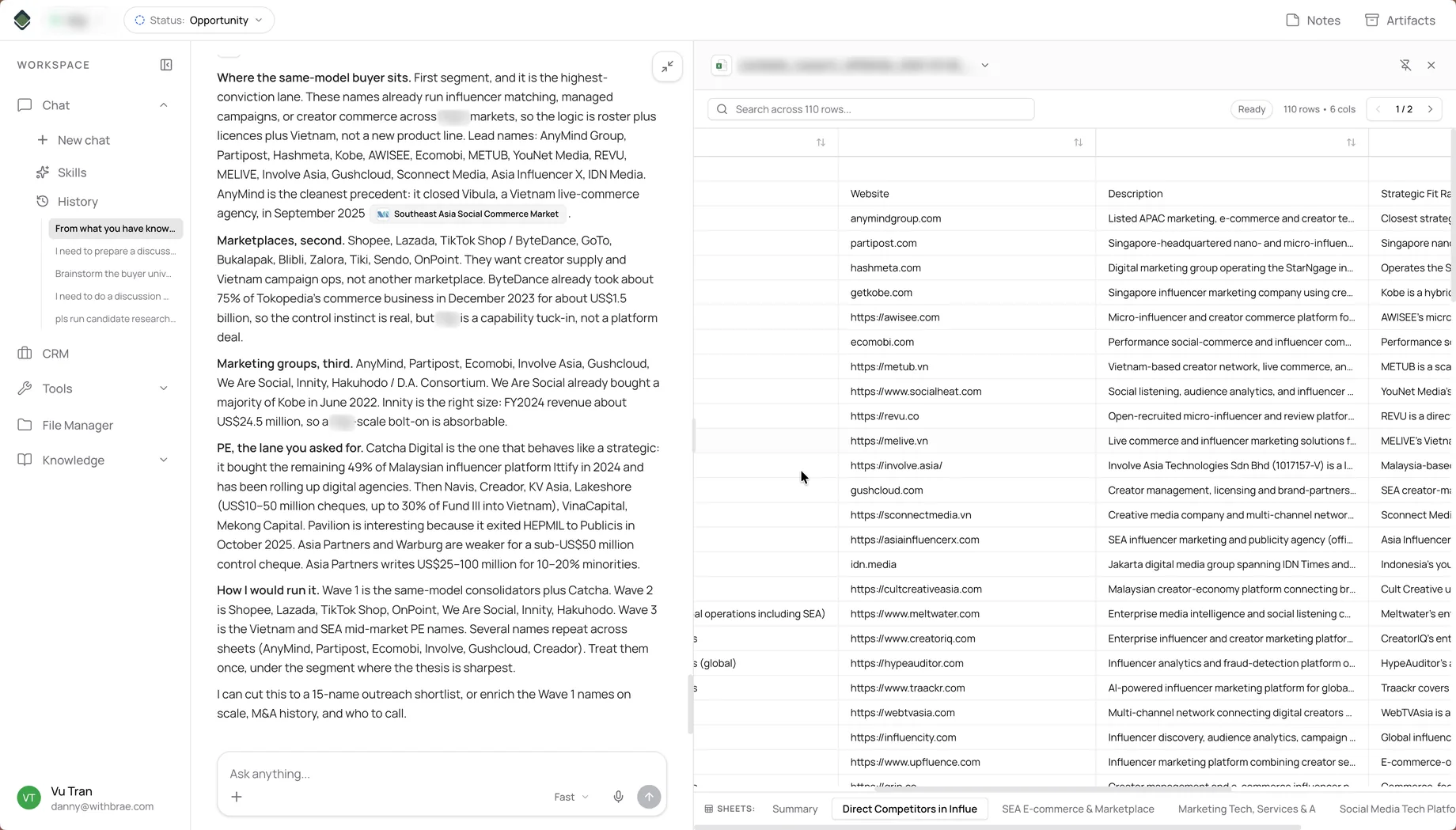
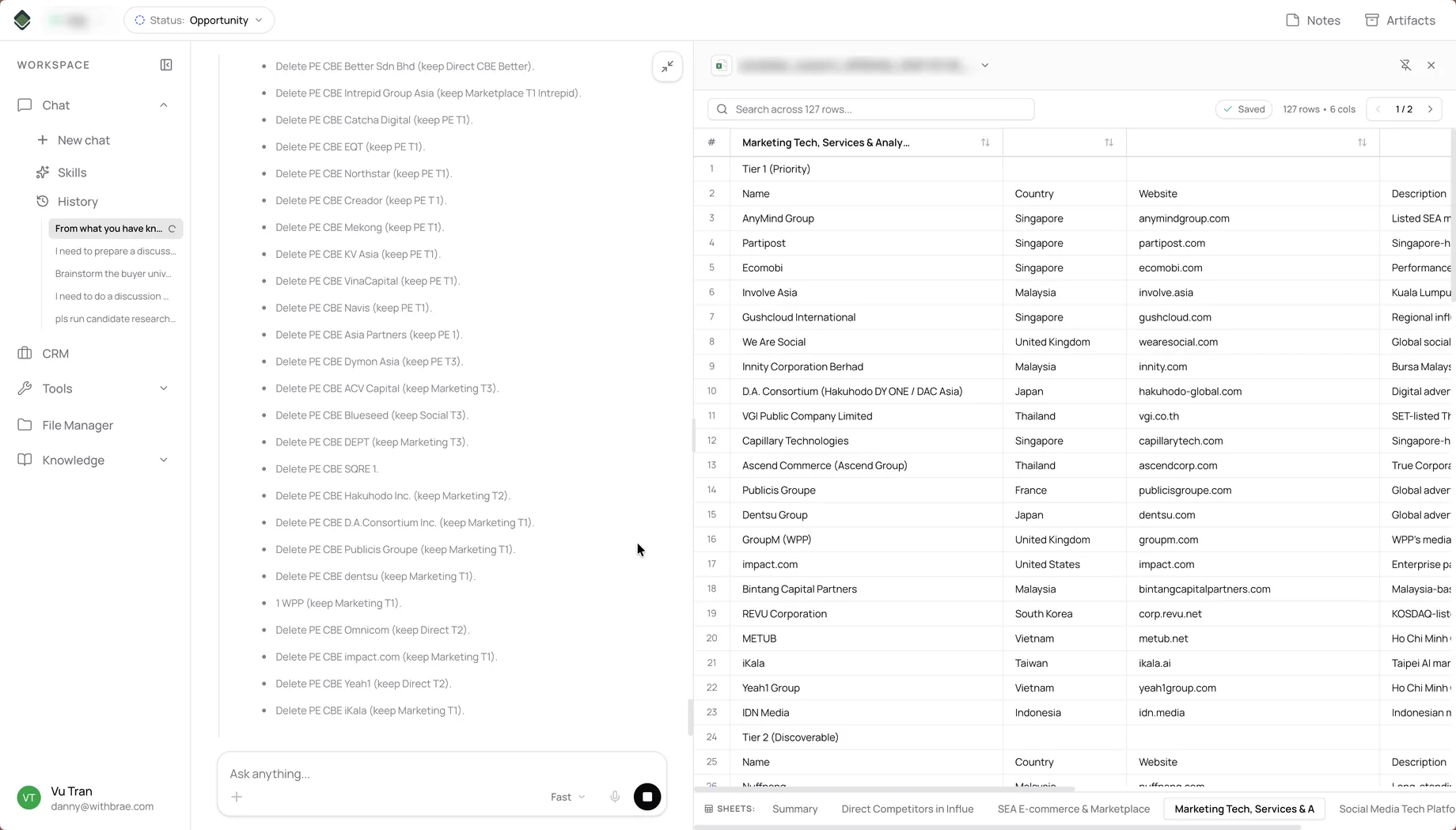
- One founder doubted us at first. He took me for a random freelancer, and he was already hearing pitches from established Japanese M&A advisors. So I put together a list of more than 100 prospective buyers and knocked on his door the next day. We won the mandate.
Since then we have approached more than 200 buyers. Five signed NDAs, and one has made an offer.
 (opens the full-size image in a new tab)
 (opens the full-size image in a new tab)
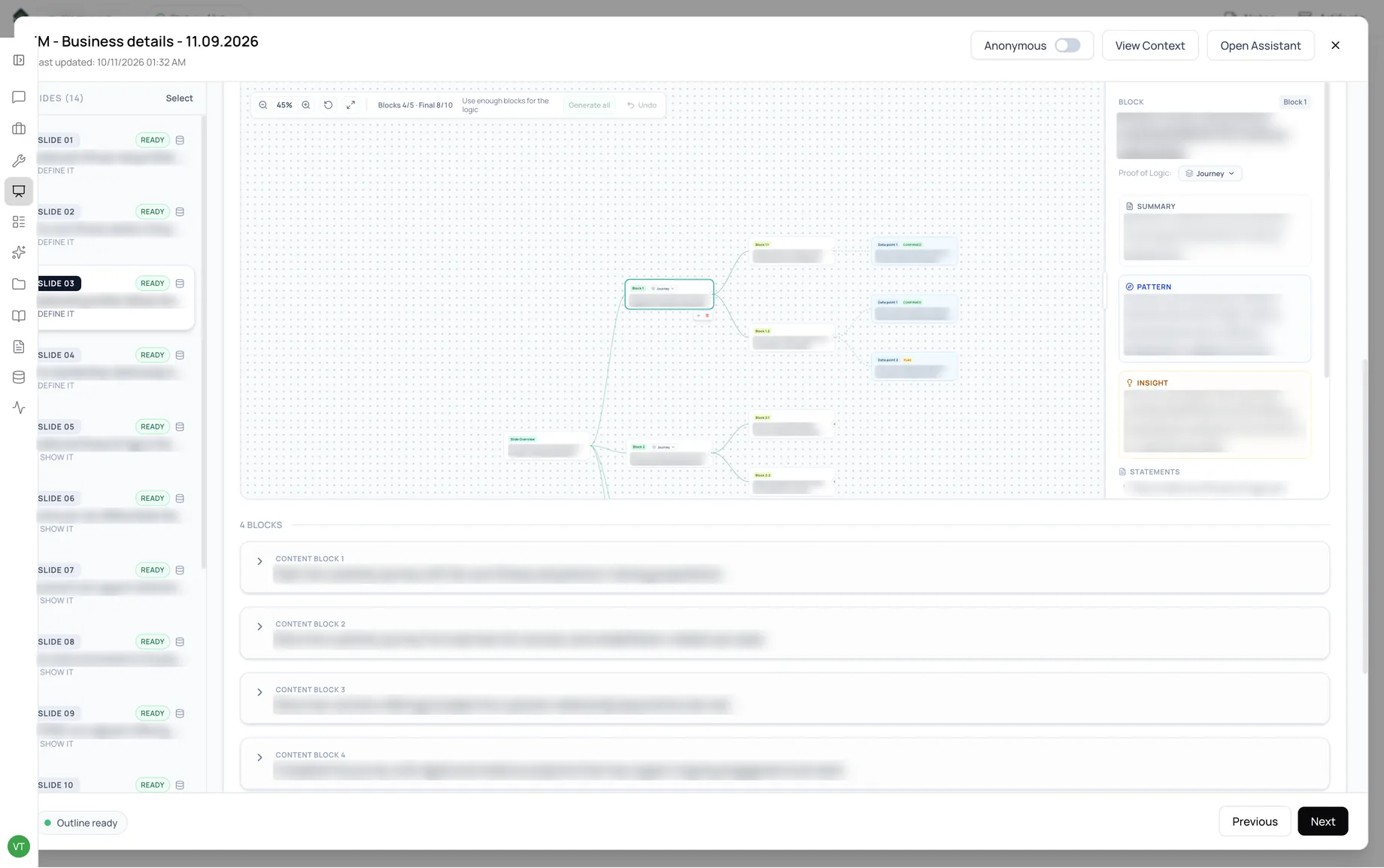
- On one mandate we produced a full CIM, the document buyers read first, in a week. The work ran end to end on our platform: the narrative first, then the slides laid out on a canvas, then handed to our PowerPoint add-in for the final file.
At the pace I was trained on, that takes a month.
 (opens the full-size image in a new tab)
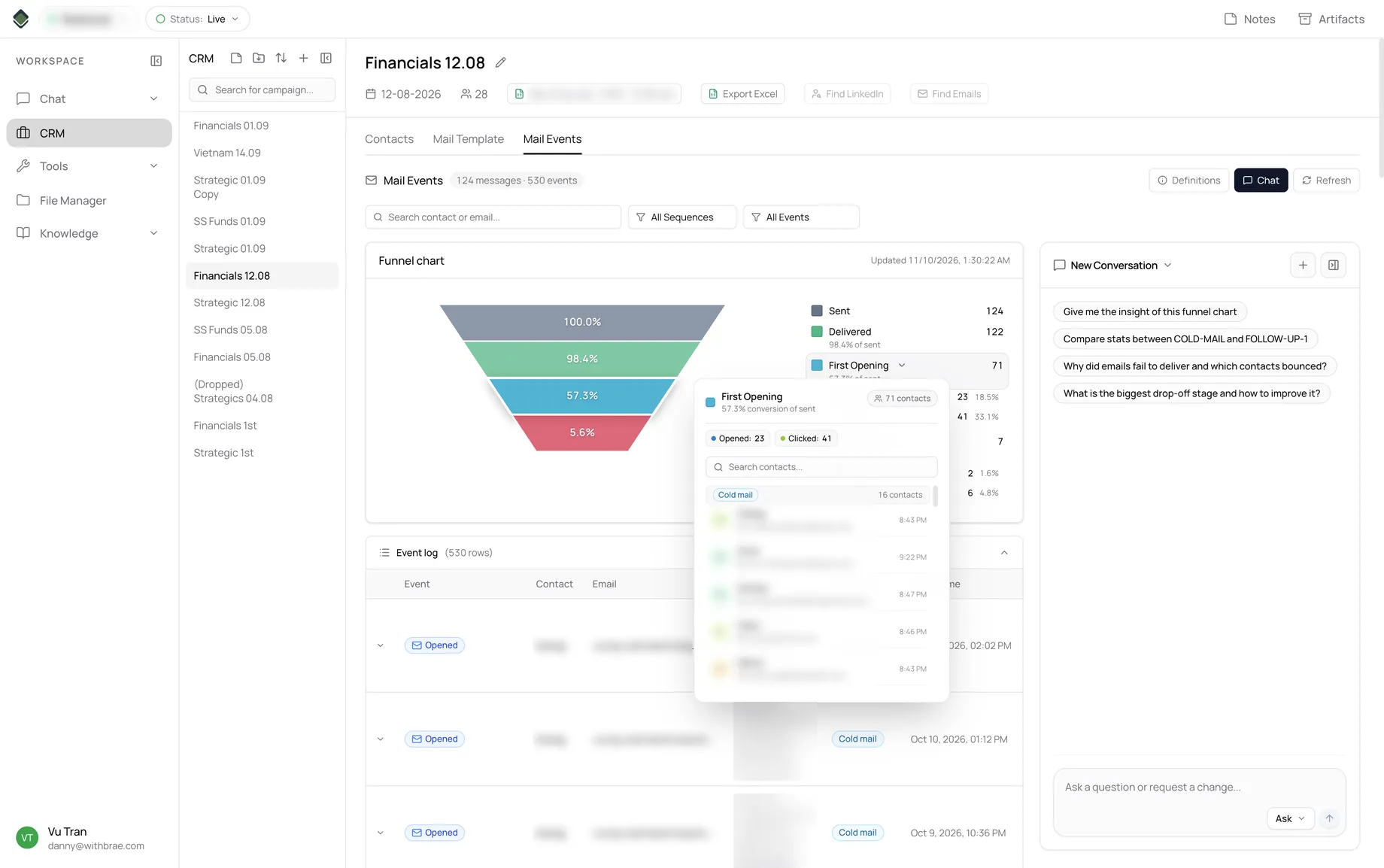
- Our CRM keeps every buyer conversation in one place. On one live deal it tracks 100 buyers and the follow-ups due for each, so the founder can see where every buyer stands at any time.
 (opens the full-size image in a new tab)
This model is not a guess. In Japan, M&A Research Institute (Masouken) was founded in 2018 to serve owners nearing retirement with no successor. It charges sellers nothing until a deal closes, builds its matching and workflow software in-house, and closes in about six months on average, where the company says others can take more than a year. It listed on the Tokyo Stock Exchange four years after it started.10
III. Our conviction
Engineers now ship whole repositories from a spec without reading every line. Bankers can build a model the same way, without checking every cell, if three things hold:
- Every number can be traced back to its source and queried.
- QA/QC (quality assurance and quality control) is built into each stage, not saved for the end.
- The context of the deal, usually cluttered across fragmented data streams, is indexed, embedded and streamlined so AI can work with it.
Those three were what the old workflow was really protecting. The tools were incidental.
Here is how a deck gets built now. The steps are the ones a deal team has always followed. What we engineered is the know-how inside each step. We start from one umbrella narrative. An AI VP turns it into a slide-by-slide narrative. An AI junior analyst researches each slide and builds the supporting statements behind it. An AI junior designer looks up our slide library and balances the template against the slide in hand. An AI MD reviews the whole deck for consistency and storyline. On some deals we are now rebuilding the entire deck with image generation.
Umbrella narrative
One storyline for the whole deck.
Slide-by-slide narrative
An AI VP turns the umbrella narrative into the story each slide has to tell.
Supporting statements
An AI junior analyst researches each slide and builds the statements behind it.
Slide design
An AI junior designer looks up the slide library and balances the template against the slide.
Review
An AI MD reviews the whole deck for consistency and storyline.
Breaking the work into separate workstreams gives us two things:
- We are model-agnostic. Each model is great at a certain subset of tasks, so each workstream gets the model that does it best.
- We can do it at scale. Because we control how tokens are spent, we can generate 50 decks in-house concurrently, instead of waiting in line on a single assistant.
The frontier labs are already going around the legacy platforms. A deck no longer has to begin in PowerPoint; the formats AI works in natively are HTML and JSON. We run client onboarding, information requests and progress updates on our own platform, and the buyer side works the same way.
As I write this, Claude has just launched dashboards and motion pieces that you can create and edit in place.11 So think about it: what if the next CIM or teaser were HTML-native? What if a buyer could interact with the assets, running scenarios, sorting and filtering the data, or querying a chart, instead of reading a plain PDF exported from PowerPoint?
The consequence is that work once too expensive to do before a mandate is now cheap. So we do it first. We've built buyer lists for portfolio company exits and handed them to several funds, just to start the conversation.
The same engine runs the other way for funds. Give it a meeting note, and it drafts the target segments to research, then waits for a dealmaker to approve before it runs.
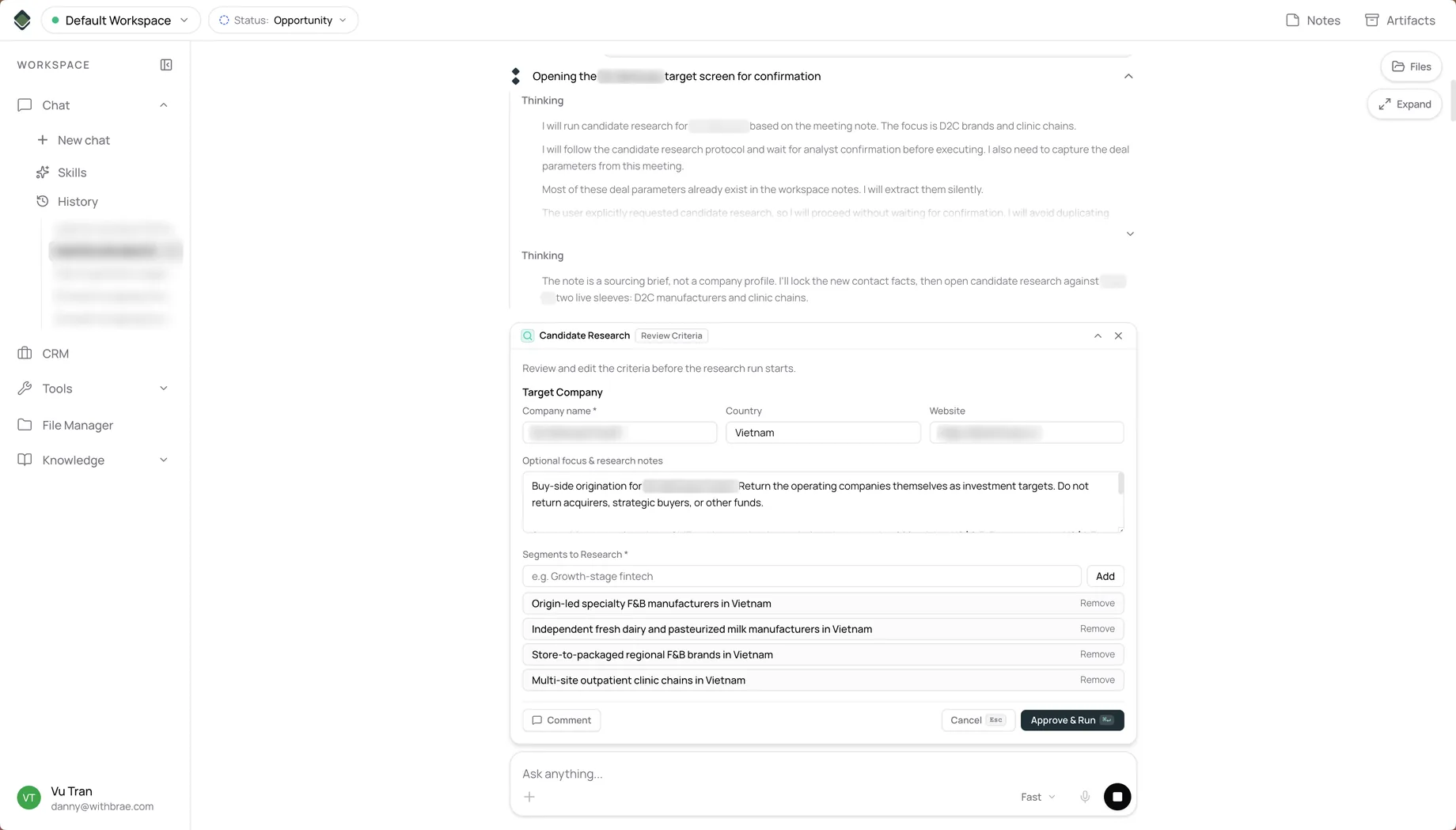 (opens the full-size image in a new tab)
IV. An AI-native firm
An AI-native firm needs an AI-first foundation in three places: the organization, the culture and the workflow. Most people start with the workflow, because that is where the tools are. The organization and the culture are what they miss.
You have to be AI-native at the level of the operating system, meaning how people are organized and how they work, before you can master any AI platform. It is like trying to digitize a company where nobody has learned to use the internet or run a proper search. The tools arrive, and nothing changes.
At BRAE we double down on our own tech to do real deal execution, and the same habit runs through the whole company. Our engineers work AI-native too: tickets get cleared by AI agents, not only by hand.
One rule holds it together. When something comes out wrong on a deal, the dealmaker does not fix it by hand. The dealmaker sends a ticket to the tech team. If the narrative is wrong, or the slide library doesn't work for a slide, that does not mean an analyst redoes it manually. Every issue goes through the tech team, so the fix lands in the product and the next deal gets a better service.
So it is not only the workflow. It is the culture. From engineering to deal execution, we try to automate ridiculously petty tasks, the ones nobody thinks are worth automating. We can find them because we are operators: we run the deals ourselves, so we know which small things eat the day.
Some examples:
- An AI agent creates the ticket straight from our team chat.
- Another takes every deck we upload, breaks it down and embeds it in the slide library.
- We built our own observability in-house: when a task fails, we can see which tool failed.
This is where our operational strength comes from:
- Two dealmakers, five live deals. Together the five mandates are worth US$45m.
- Where the hours go. About 80% of our work is now prompting and thinking through strategy, even in Excel and PowerPoint. The other 20% is finishing touches, or editing a few things directly.
- Skills run both ways. Our dealmakers are the product owners, so a dealmaker needs a product manager's skill set. And our engineers know deals for real: any of them can be put on a live deal and work it with the product.
The goal is not fewer people. It is that everyone's hours go to the founder and the deal.
V. What comes next
BRAE's commitment to this problem is total. The business built on it is not perfect. Advisory revenue doesn't recur. Sales cycles are long. Every mandate starts from zero. And even among AI-native service firms, M&A is the rare choice. Insurance and accounting are lucrative and check every box: recurring revenue, and a pain point that never goes away. M&A checks neither. Most people read those as reasons to stay away. They are the reason the opportunity is still here.
So we are going to focus. BRAE is a technology company that does deals, not an advisory firm that uses software. We are pursuing the first one-person billion-dollar company. Companies like that get built in businesses like this one, where the work used to need a pyramid of people and no longer does. That is the direction we are building in: a small team, with technology carrying the scale.
The next step is to take the advisory service apart. We are turning it into modules, packaging them, and putting them directly into founders' hands. If it works, good advice stops being something only a few companies can get. More to come.
Some things are not proven yet. A success fee means months of work before any money arrives, and a deal can still die in its last week. A team this young gets doubted before it gets heard, and that is fair. The only answer is results.
In 1803 it took two of Europe's great banks to finance a single deal. Two centuries later, that kind of help still reaches very few companies. We want it within reach of every founder in Vietnam who needs it.
If you're a founder thinking about what comes next for your company, or a fund with an exit to plan, I'd like to talk. Write to me at [email protected].
Sources
-
Forbes, "Shunsaku Sagami", 28 April 2023 (Spanish). logmi Finance, M&A Research Institute results briefing, 20 November 2025 (Japanese). ↩
-
Vietnam Law & Legal Forum, "Politburo's resolution on private economic sector development", 5 May 2025. ↩
-
World Bank, "Viet Nam overview". ↩
-
The Investor, "Vietnam M&A 2025: Opportunities reshaped by disciplined capital", 17 December 2025. ↩
-
Hai Phong News, "Real-estate credit shifts focus with stronger controls on speculation", 16 June 2026. ↩
-
Viet Nam News, "Việt Nam puts an end to lump-sum tax, aiming for a level playing ground", 27 October 2025. ↩
-
Viet Nam News, "NA approves resolution targeting average annual growth of at least 10% in 2026-30", 24 April 2026. ↩
-
The Baring Archive, "The Louisiana Purchase". ↩
-
Tech.eu, "London and New York-based Model ML raises $75M", 24 November 2025. Model ML, "About". ↩
-
M&A Research Institute, "Reasons to choose us" (Japanese). Forbes, "Shunsaku Sagami", 28 April 2023 (Spanish). ↩
-
Anthropic, "Build live dashboards and animate explainers with Claude", 8 October 2026. ↩